
SSS Applications
Mine Water Treatment
Mine water may be acidic (metal containing weak sulphuric acid solutions) or neutral with elevated sodium. In the traditional treatment approach, lime is added to neutralise and precipitate metals. In the process, large volumes of gypsum are co precipitated forming a waste stream with the metal hydroxides. This is followed by membrane concentration, typically Reverse Osmosis. The brine is either disposed or if Zero Liquid Discharge is required, the go to solution is then evaporation & crystallisation, or freeze desalination.

Our SSS process enables the use of caustic soda (NaOH) instead of lime. No gypsum precipitation! The membrane concentration process can now achieve significantly higher recoveries and higher brine concentrations, the brine reporting as sodium sulphate solution after impurity removal.

The sodium sulphate solution is then fed to the salt splitting plant, returning caustic soda for reuse, and making sulphuric acid and excess caustic soda available for potential sales.
Conventional
- Significant reliance on lime as input process chemical
- Significant solid waste volumes
- Low probability of metal beneficiation
- Difficult neutralisation process conditions
- Super-saturated calcium sulphate solutions limit water recovery in membranes
- All salts report as waste
Salt Splitting AMD Treatment
- No reliance on input process chemicals
- Insignificant solid waste volumes
- High probaility of metal beneficiation
- Sub-saturated sodium sulphate solution maximise water recovery in membranes
- Negligible salts report as waste
Flue Gas Desulphurisation (FGD)
Flue gas from installations (such as power stations) where fossil fuels are used consist of excess levels of sulphur dioxide (SO2). Excess levels of this gas lead to acid rain and can cause respiratory problems in humans.
To prevent this harmful gas from entering the atmosphere, scrubbers should be employed to remove it. Not many power station installations have installed such scrubbing systems.
The conventional scrubbing system uses a lime solution. During this contact process, the sulphur dioxide combines with lime and oxygen to form gypsum.
Numerous issues are experienced with these scrubbing systems.
- High volumes of lime need to be purchased and added to the scrubber.
- Significant volumes of waste gypsum are generated that require disposal.
- Most of the fluid is in slurry form (i.e. solid/liquid mixture), presenting significant issues in terms of blockages and maintenance.
- The generated wastewater is difficult to treat.
The use of caustic soda in such scrubbing systems is technically far superior to the lime-based systems. It provides the opportunity for better control, no solids (input or output) need to be handled and the SO2 removal efficiency is better.
Traditionally, the major reasons for not employing the caustic-based systems are the high cost associated with the continuous purchasing of fresh caustic soda and the generation of large volumes of liquid sodium-based effluents, which is expensive to treat.
The SSS technology overcomes these concerns.

For FGD treatment, a 5-10% concentration caustic soda is pumped to the scrubber. On its way to the scrubber, ozone is added to ensure the oxidation of SO2 to SO3. The SO3 reacts with sodium hydroxide to form dissolved sodium sulphate. The desulphurised flue gas is safely routed to atmosphere.
The spent solution is fed into the SSS process to form caustic soda which is reused in the scrubber, and sulphuric acid that can be sold into the market.
This allows for substantial savings in chemical purchases and a significant reduction in waste production. In conjunction with the sale of sulphur or sulphuric acid, significant contributions to the company’s bottom line can be achieved.
The benefits are not only monetary, but significant environmental benefits are also achieved since the amount of discharged waste is significantly reduced, and the efficiency of sulphur dioxide removal is improved.
The main input chemical does not need to be purchased but is produced on-site using a potential waste stream as source, in true circular economy style. This has the added benefit of not requiring chemicals to be transported to site, further improving environmental benefits. The process is no longer dependent on the availability of input chemicals.
Hydro-Desulphurisation
Sulphates in metal concentrates are normally removed using thermal processes, which are energy intensive and present air emissions challenges.
An emissions-friendly process is available whereby sulphates can be removed in the water phase using caustic soda (NaOH). The drawbacks of this process are the high cost of caustic and the sodium sulphate waste stream so produced.
By feeding the produced sodium sulphate to our sodium sulphate splitting (SSS) technology, one can produce all the required caustic for desulphurisation. This means no caustic must be purchased anymore. At the same time, the production of waste is prevented.
To sweeten the deal, sulphuric acid is produced that can be sold into the market.
This allows for substantial savings in chemical purchases and a significant reduction in waste production.

SSS finds particular application in the hydrometallurgical route of lead acid battery recycling, perhaps the best example of the circular economy. By reproducing sodium hydroxide within the process, one has a circular economy within a larger circular economy.
Spent Caustic Treatment
Caustic soda is used in many petrochemical and oil refining application as a scrubbing agent to remove sulphides, cresylates and naphthenates. These combined streams form waste streams commonly referred to as spent caustic streams. The disposal of these streams is typically problematic.
It has been shown that the streams can be treated using Hydrothermal Oxidation. All hydrocarbons can be converted to water and carbon dioxide if oxidation occurs at high temperature and pressure, above the critical point of water. When oxidation occurs in the sub-critical region, sodium cresylates and naphthenates are formed. These can then be treated with sulphuric acid to form the corresponding organic acids, which can be separated from the aqueous phase by gravity separation.
The remaining aqueous phase contains dissolved sodium sulphate.
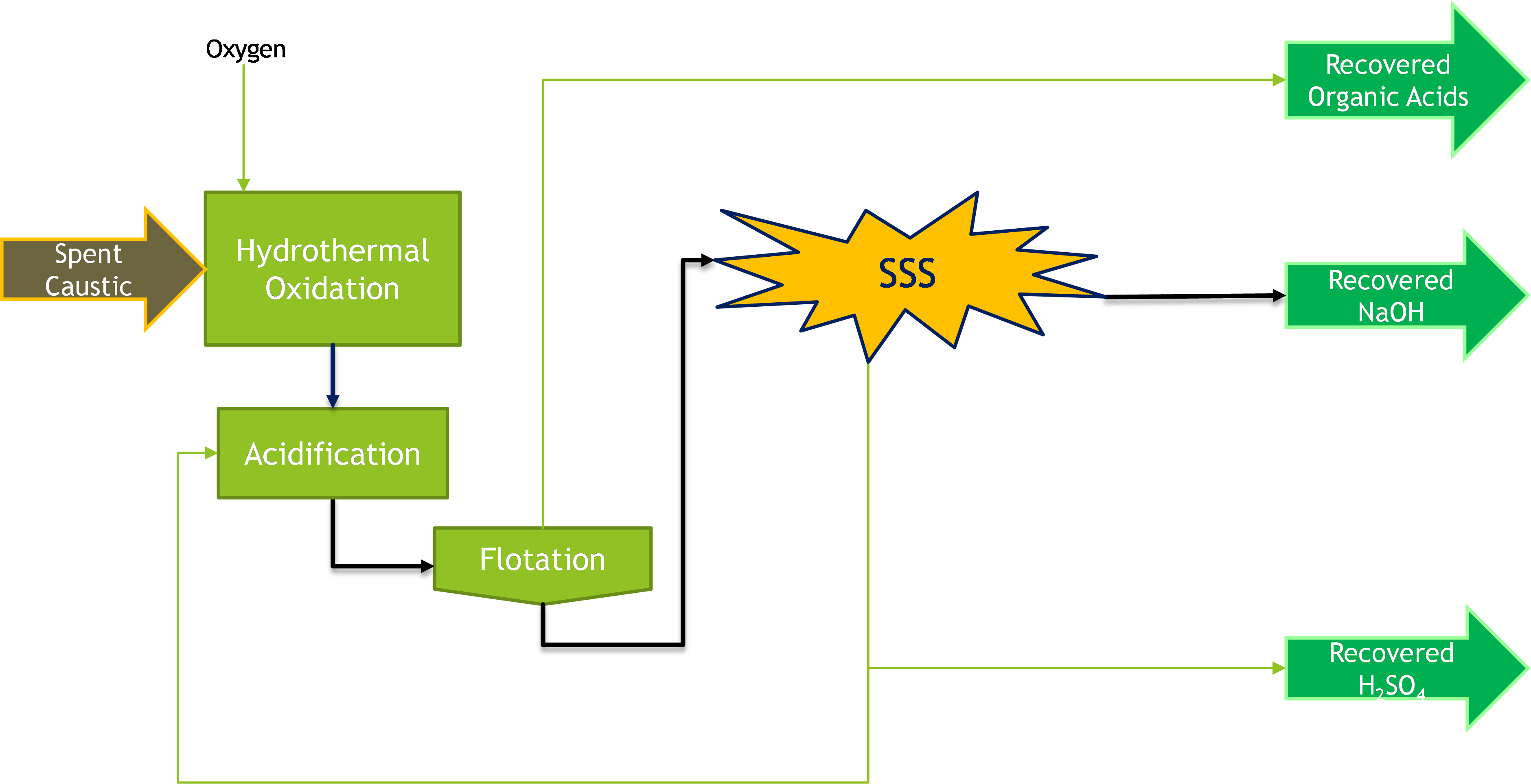
The SSS technology can split this salt and produce caustic soda to be reused in the caustic scrubbing process, thereby reducing the inbound caustic soda requirement. The required sulphuric acid is produced downstream, and excess sulphuric acid is marketed.